Events
10th December 2021
UTC 20 : 00 - 22 : 00 (2 hours)
Registration required.
Join us for a session of engaging discussion at NeurIPS 2021.
We have confirmed a wonderful line-up of mentors, who will
moderate discussions on a wide range of topics from how to build a successful research career,
to how useful reinforcement learning is in the real world,
to AI applications in finance industry and to many ethical issues associated with AI & ML.
Only limited spots are available. Don't miss out - sign up now!
The Roundtable Chatroom event consists of 2 sessions.
We dedicate the first 1h30min for a session of guided discussions on a range of important topics related to ML.
We invite mentors with expert knowledge of these topics to host these discussions.
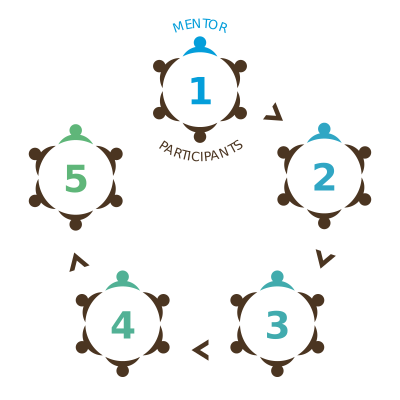
To allow quality engagement, participants will be divided into small groups of 10-15 people
and will rotate around different topics and mentors.
The last 30min is a free discussion session, where we randomly break up the participants into even smaller groups of 3-5 people.
Any topics are allowed and we hope some valuable friendships will be initiated during these conversations.
The first session will be guided by knolwedgeable mentors at different 'tables' (breakout rooms). In a group of no 10-15 people, participants will have the chance to raise any questions they have related to the topic or contribute to the discussion by sharing their opinions. The discussion of each topic lasts for 15-20min.
In the second session, we will reduce the group to even smaller size (3-5 people). There is no restriction on the topics to be brought up, although code of conduct still applies. This session is designed to allow us to build a layer of peer support, as we all share similar challenges and opportunities. Let's talk about them and help each other!
Director of Robot Learning Lab and Senior Lecturer
Imperial College London
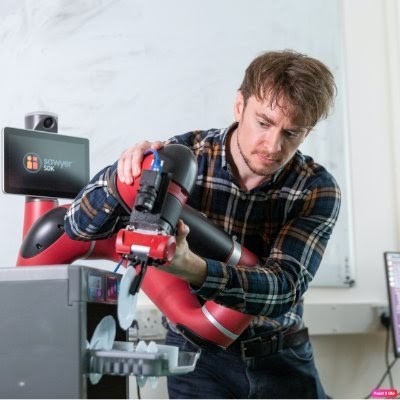
Edward is director of the Robot Learning Lab at Imperial College, where he leads the lab’s research on how robots can learn to physically interact with objects, using their arms and hands. Prior to the current post, Edward was a founding member of the Dyson Robotics Lab with Andrew Davison, where he led the robot manipulation team. In 2017, Edward was awarded a Royal Academy of Engineering Research Fellowship for his project "Empowering Next-Generation Robots with Dexterous Manipulation: Deep Learning via Simulation". Alongside leading the Robot Learning Lab's research, Edward teaches a graduate-level course on Reinforcement Learning.
Professor of Computer Science
University of California - Berkeley
Stuart is a Professor of Computer Science at the University of California at Berkeley, holder of the Smith-Zadeh Chair in Engineering, and Director of the Center for Human-Compatible AI. He is a recipient of the IJCAI Computers and Thought Award and held the Chaire Blaise Pascal in Paris. In 2021 he received the OBE from Her Majesty Queen Elizabeth and gave the Reith Lectures. He is an Honorary Fellow of Wadham College, Oxford, an Andrew Carnegie Fellow, and a Fellow of the American Association for Artificial Intelligence, the Association for Computing Machinery, and the American Association for the Advancement of Science. His book "Artificial Intelligence: A Modern Approach" (with Peter Norvig) is the standard text in AI, used in 1500 universities in 135 countries. His research covers a wide range of topics in artificial intelligence, with a current emphasis on the long-term future of artificial intelligence and its relation to humanity. He has developed a new global seismic monitoring system for the nuclear-test-ban treaty and is currently working to ban lethal autonomous weapons.
Partner Research Manager
Microsoft Research New York City
Hanna is currently a partner research manager at Microsoft Research New York City. She is also an adjunct professor in the College of Information and Computer Sciences at UMass Amherst and a member of UMass Amherst's Computational Social Science Institute. Hanna’s research focuses on issues of fairness, accountability, transparency, and ethics as they relate to AI and machine learning. Hanna and her co-authors have won best paper awards at AISTATS, CHI, and NAACL. Hanna is keen to address the underrepresentation of women in computing. To this end, she co-founded several organizations, including the annual Women in Machine Learning (WiML) Workshop, the Debian Women Project and the GNOME Outreach Program for Women. Hanna also served as the senior program chair for the NeurIPS 2018 conference and as the general chair for the NeurIPS 2019 conference. She currently serves on the NeurIPS Executive Board, the ICML Board, the FAccT Steering Committee, the WiML Senior Advisory Council, and the WiNLP Advisory Board.
Faculty Member
Oxford-Man Institute of Quantitative Finance
Stefan is a Faculty Member at the Oxford-Man Institute of Quantitative Finance, a Research Associate at the Oxford Internet Institute and a Mentor in the FinTech stream at the Creative Destruction Lab at Said Business School, all at the University of Oxford. He also acts as Scientific Advisor to Man Group. Stefan’s research is focused on applied machine learning in finance, including deep learning, reinforcement learning, network and NLP approaches. He is also interested in exploring early use cases of quantum computing. At the Oxford Internet Institute, Stefan teaches the intensive module on Machine Learning and the elective on Applied Machine Learning as part of the MSc in Social Data Science. He also acts as an MSc thesis supervisor with previous projects covering financial news networks and analyses of social lending platforms.
Professor of Computer Science and Engineering
University of Washington
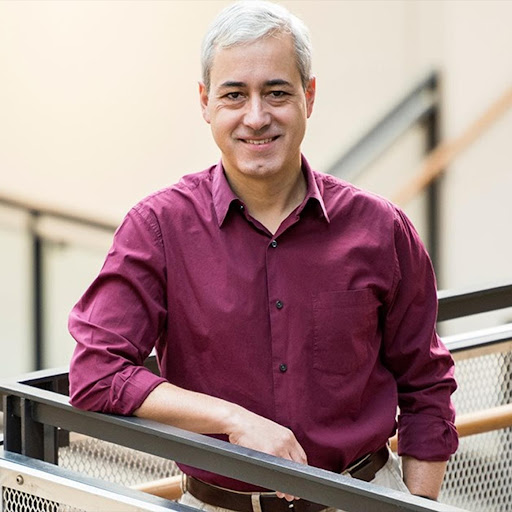
Pedro is a professor of computer science and engineering at the University of Washington and the author of The Master Algorithm. He is a winner of the SIGKDD Innovation Award and the IJCAI John McCarthy Award, two of the highest honors in data science and AI. Pedro also serves as a Fellow of the AAAS and AAAI, and he has received an NSF CAREER Award, a Sloan Fellowship, a Fulbright Scholarship, an IBM Faculty Award, several best paper awards, and other distinctions. To date, Pedro has (co-)authored over 200 technical publications in machine learning, data mining, and other areas. He also serves as a member of the editorial board of the Machine Learning journal, co-founder of the International Machine Learning Society, and past associate editor of JAIR. Pedro was the program co-chair of KDD-2003 and SRL-2009, and he has also served on the program committees of AAAI, ICML, IJCAI, KDD, NIPS, SIGMOD, UAI, WWW, and others. Pedro enjoys making scientific research more accessible to the general public. He has written for the Wall Street Journal, Spectator, Scientific American, Wired, and others.

UTC 19 : 00 - 21 : 00 (Virtual)
- - - - - Topics discussed - - - - -